
A Thousand Years, Still Warm
On taste, time, and what survives both

Next: [What We Train Ourselves Not to Notice]
Some time ago, an American friend wrote to ask whether I might meet a friend of his who was coming to Japan.
“She’s great fun,” he said. “And she has a Ph.D. I think you’ll get along.”
He was right.
This is the story of a day I spent showing her around Kyoto, the city where I was born and where, in the twenty-seven years up to that point, I had never lived anywhere else long enough for it to count as leaving.
A Thousand Years, Still Warm
I began where Kyoto, to my mind, begins.
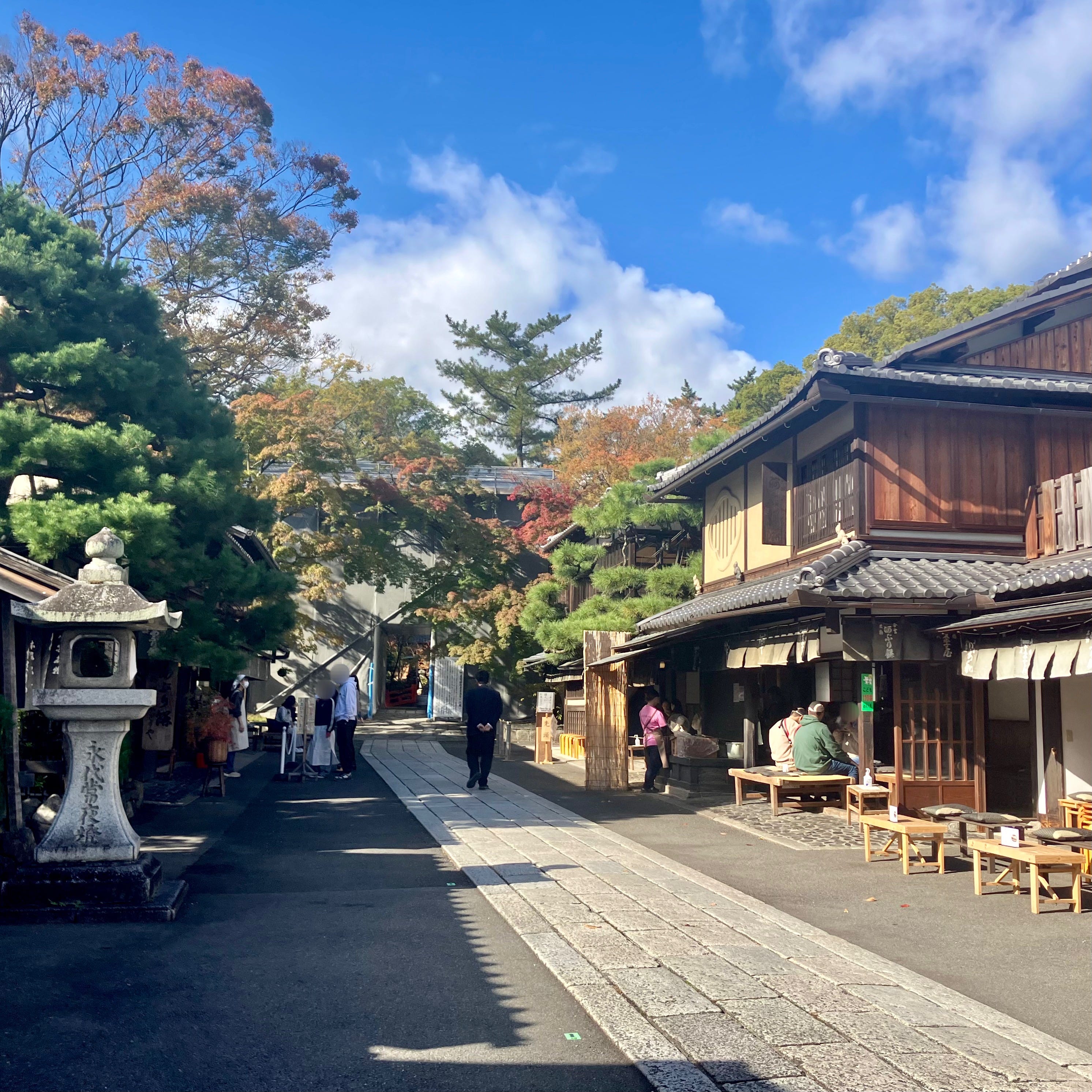
I took her first to Ichiwa Ichimonjiya Wasuke, where they make aburi mochi.
Kyoto has no shortage of celebrated sweet shops, and I have spent a fair amount of my life dutifully investigating them. This one has always felt less like a shop than an exception.
It has been there for a thousand years.
Not the sweet. The shop.
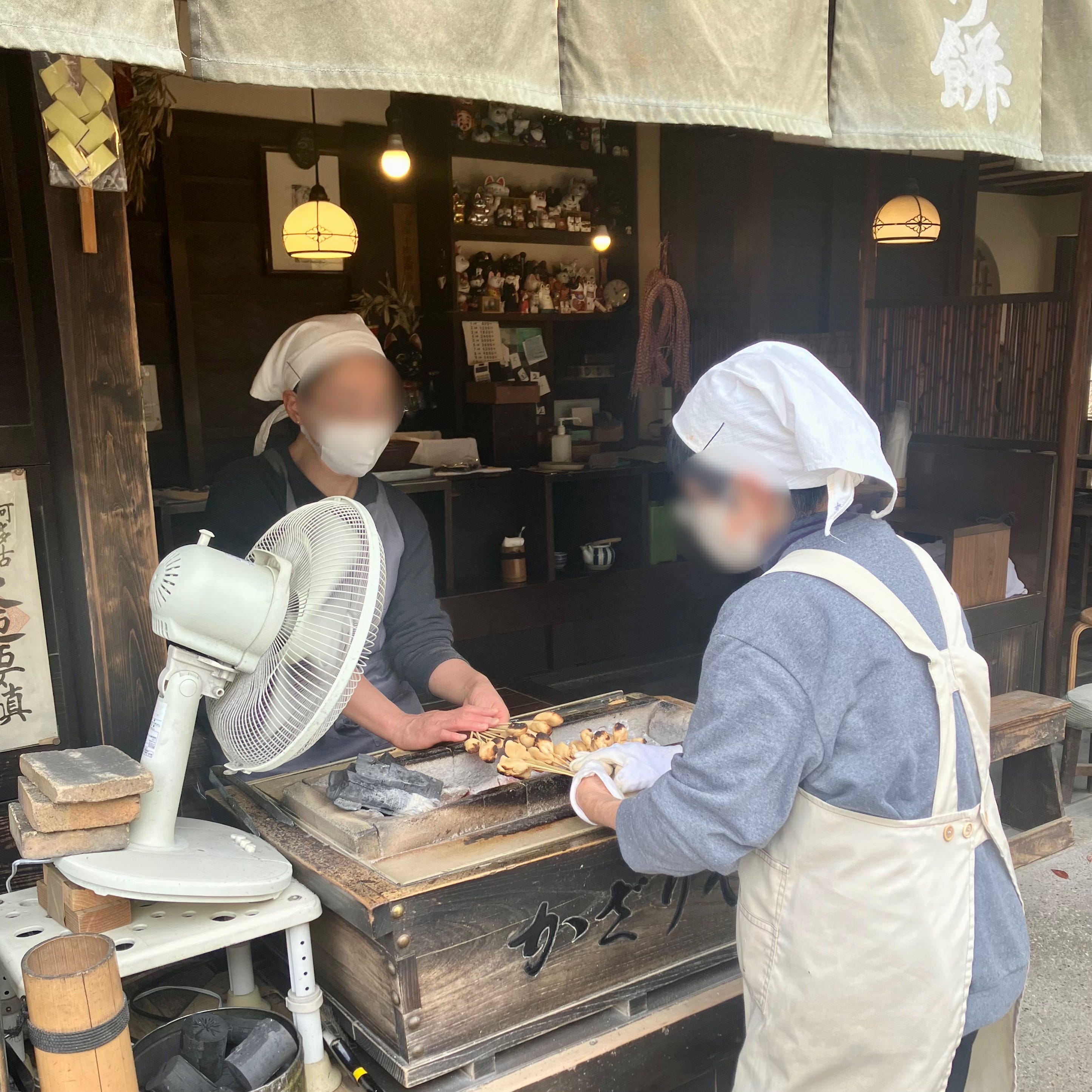
This is generally accepted without much fuss as the oldest confectionery business in the world, which sounds like the sort of claim people ought to argue about and somehow never do.
The approach to Imamiya Shrine announces it before you arrive. Somewhere ahead, rice cakes are blistering over charcoal, and the air smells faintly singed and sweet, as though autumn itself had caught at the edges.
Inside, we slipped off our shoes and stepped onto tatami. The room opened onto a small garden, green and luminous in that Kyoto way that makes even late autumn look freshly watered.
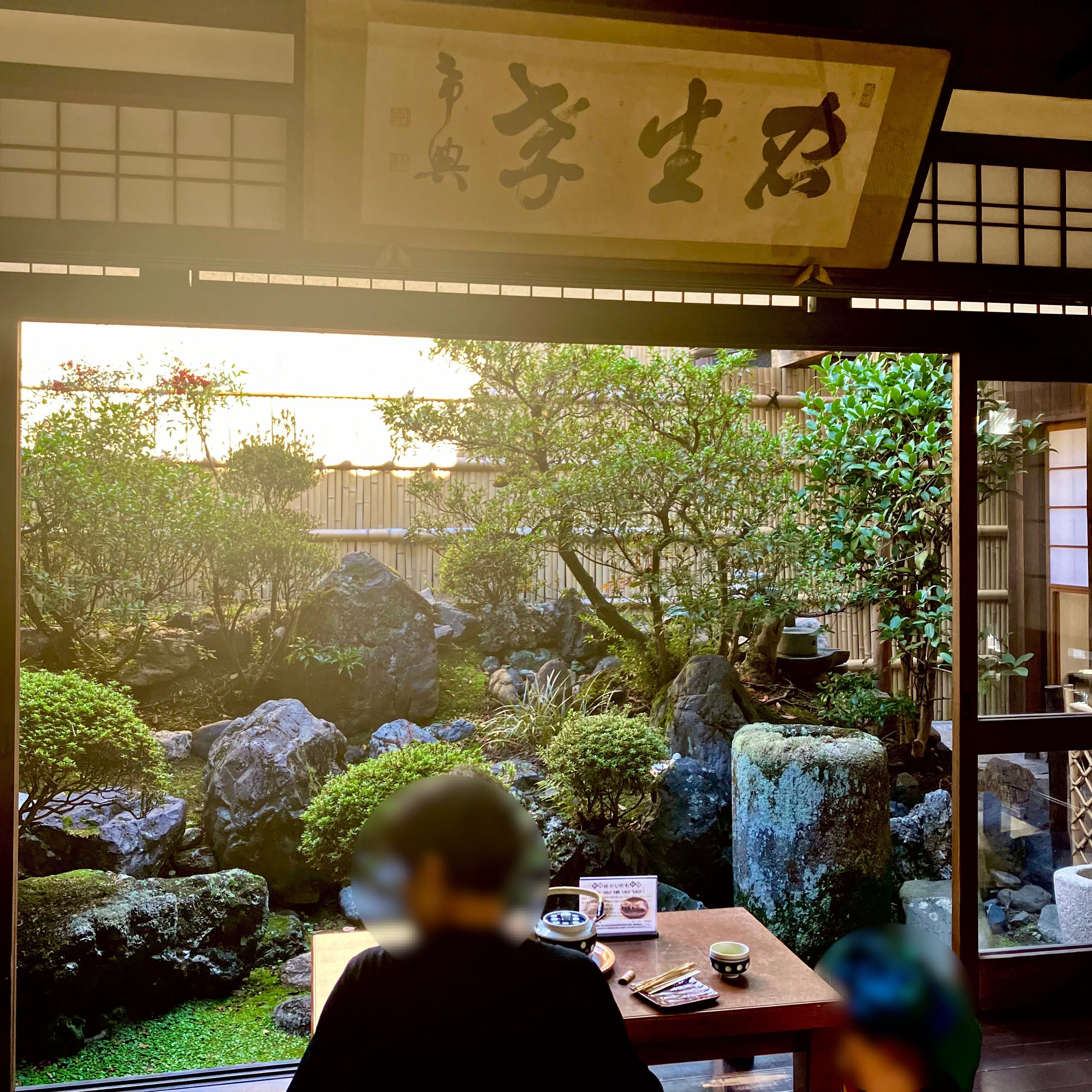
We sat for a while without speaking.
There is only one thing on the menu: Aburi Mochi.
In a city where Japanese sweets proliferate seasonally and philosophically, where each shop seems obliged to invent some new expression of refinement, this place has spent a millennium making exactly one thing and apparently sees no reason to revisit the decision.
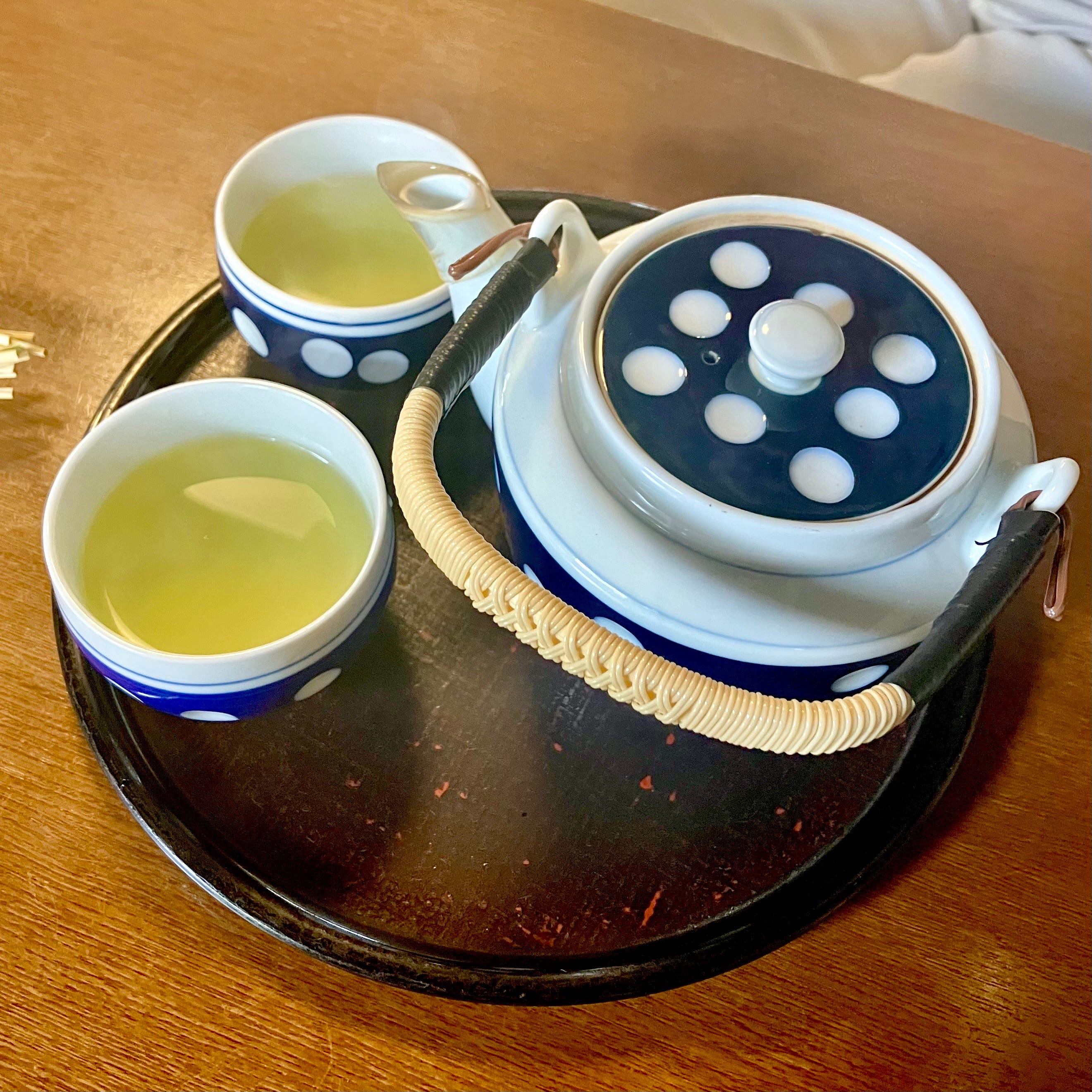
Tea arrived.
What surprised me was how delighted she seemed by it. She looked at the cup with the mild astonishment usually reserved for small magic tricks.
In Japan, complimentary tea is so routine it barely registers. Watching her react to it as though it were a thoughtful gesture rather than infrastructural fact, I briefly felt like a tourist in my own country.
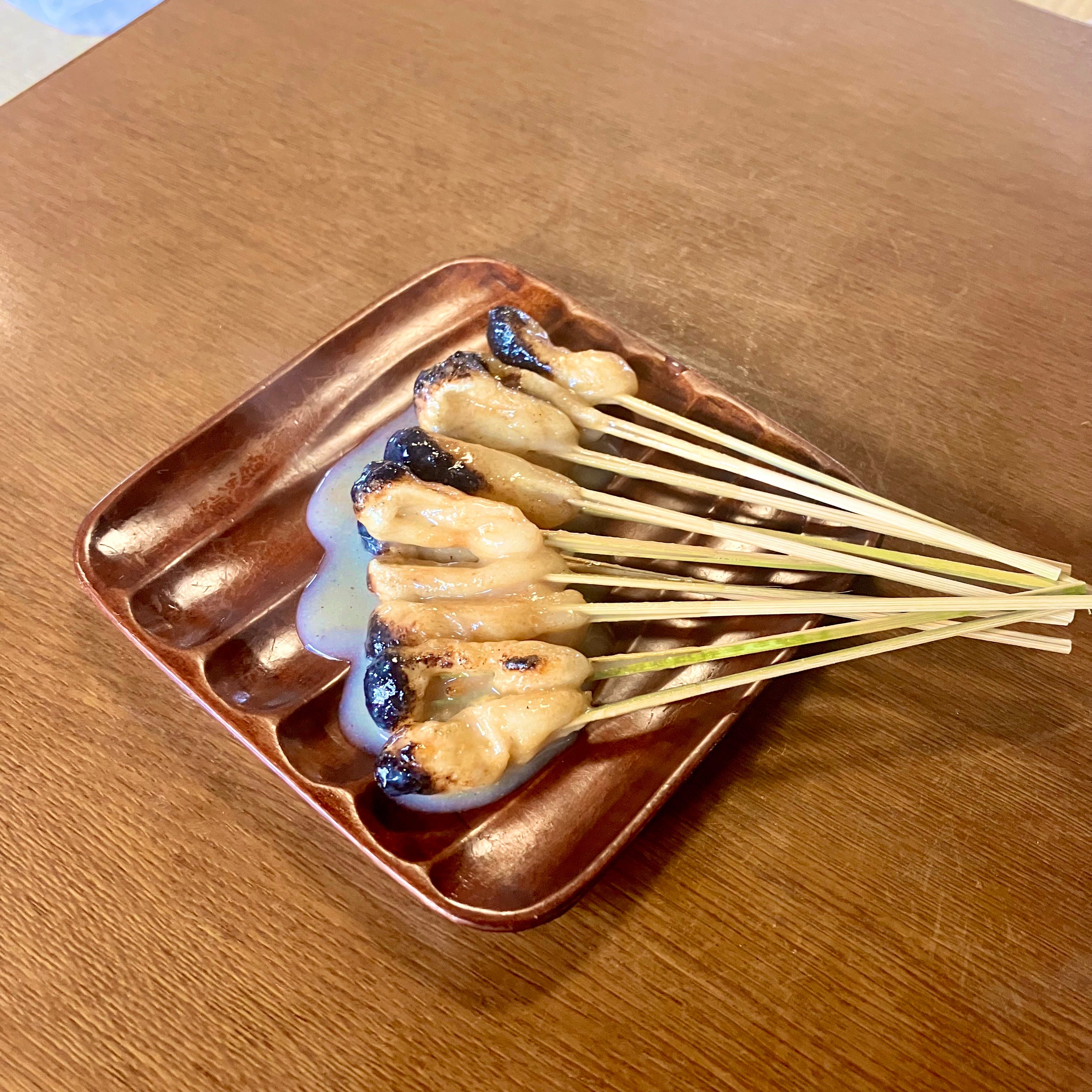
Then the mochi arrived: ten small skewers, still hot from the grill.
The rice cakes were soft and lightly charred, glossed with white miso sauce. There was the fragrance of toasted soybean flour, the mellow salt-sweetness of the glaze, and beneath that the quiet grain of pounded rice itself, sweet in the way rice is sweet when left alone long enough to explain itself.
She took a bite and looked up.
“I’ve never had mochi like this.”
I knew what she meant.
Elsewhere, mochi usually means what we would call gyūhi: smooth, elastic, immaculate in a way that suggests engineering.
This was not that.
Calling the two by the same name is a little like calling Pringles potatoes—technically forgivable, spiritually suspect.
Real mochi has a certain resistance to it, a memory of grain. It tastes faintly of work. Gyūhi, for all its charms, is more polished, more eager to please.
When I told her people had been eating this here for more than a thousand years, she looked genuinely startled.
She is from Rome, where a thousand years is not generally considered an impressive age for anything still standing. But even Rome cannot offer many places where one may sit down and casually eat the same thing people were eating a millennium ago.
Stranger still, it is good.
Not historically interesting. Not admirable for its longevity.
Just good.
Human taste, it seems, has changed less than we like to imagine.
The Unknown
For all its peculiar distinction, the oldest confectionery in the world seemed to have escaped the world’s attention.
Most of the customers were Japanese. There were no queues curling into the street, no cameras held aloft, none of the breathless international urgency that tends to gather around places once they have been properly discovered.
The air had that early-autumn clarity Kyoto does especially well: the first suggestion of cold, just enough to sharpen the light.
Between us lingered the mild formality peculiar to first meetings, though the afternoon sun, falling across the tatami in broad pale rectangles, seemed to soften it on our behalf.
She told me that two days before flying out, she had suddenly thought: Why not Japan?
So she booked the ticket.
She said this with the same expression one might use to mention buying toothpaste.
Then she lifted her tea cup in both hands and smiled into the steam, as though this too had worked out rather nicely.
My friend had described her as brilliant and fun. What he had omitted was the ease of her confidence—the kind that never announces itself because it has no need to.
When I suggested several possibilities for lunch, she dismissed them all with a small flick of the wrist.
“You choose,” she said. “Anything.”
“Something familiar,” I asked, “or something completely unknown?”
“The unknown.”
The answer came so quickly it felt less like a preference than a reflex.
Just to see how far this extended, I asked whether raw egg would be a problem.
Without a word, she reached for her phone and showed me a photograph of the yukhoe she had eaten the night before, with the faintly pleased expression of someone presenting evidence in a legal proceeding.
At that point, things became clear.
There are people for whom unfamiliarity registers as warning.
And there are people for whom it registers as invitation.
We belonged, evidently, to the second category.
In the presence of that sort of curiosity, the ordinary logic of one’s upbringing—the little inherited cautions that shape taste and habit—tends to retreat rather quickly.
Once I understood this, there was really only one place left to take her.