

I like baking with flour, butter, and sugar for a simple reason: the outcome is predictable.
My work is defined by the unexpected. Urgent tasks materialize out of nowhere, team members cycle in and out, and fresh domains are added to my plate. Don't get me wrong—I enjoy the chaos. But in my personal hours, knowing that a strictly followed sequence will yield the exact same flavor is a quiet consolation.
Yet, baking with raw, unrefined produce destroys that predictability.
An apple pie may emerge from the oven looking flawless—its crust golden, fragrant, and flaky and crisp—only to reveal a soggy bottom upon the first slice. When a pumpkin carries too much moisture, the resulting cake turns out dense and heavy. And even after waiting for a banana to become thoroughly freckled with brown spots, the banana bread I folded it into lacked any discernible sweetness.
Vegetables and fruit refuse to stay constant. Even when harvested from the same soil and belonging to the exact same variety, one specimen will prove waterlogged, another fibrous, another stubbornly hard.
A "standard recipe" guarantees neither standard flavor, nor texture, nor appearance.
Which is why I am consistently struck with awe by a simple, yellow bar: Funawa’s Imo Yokan.
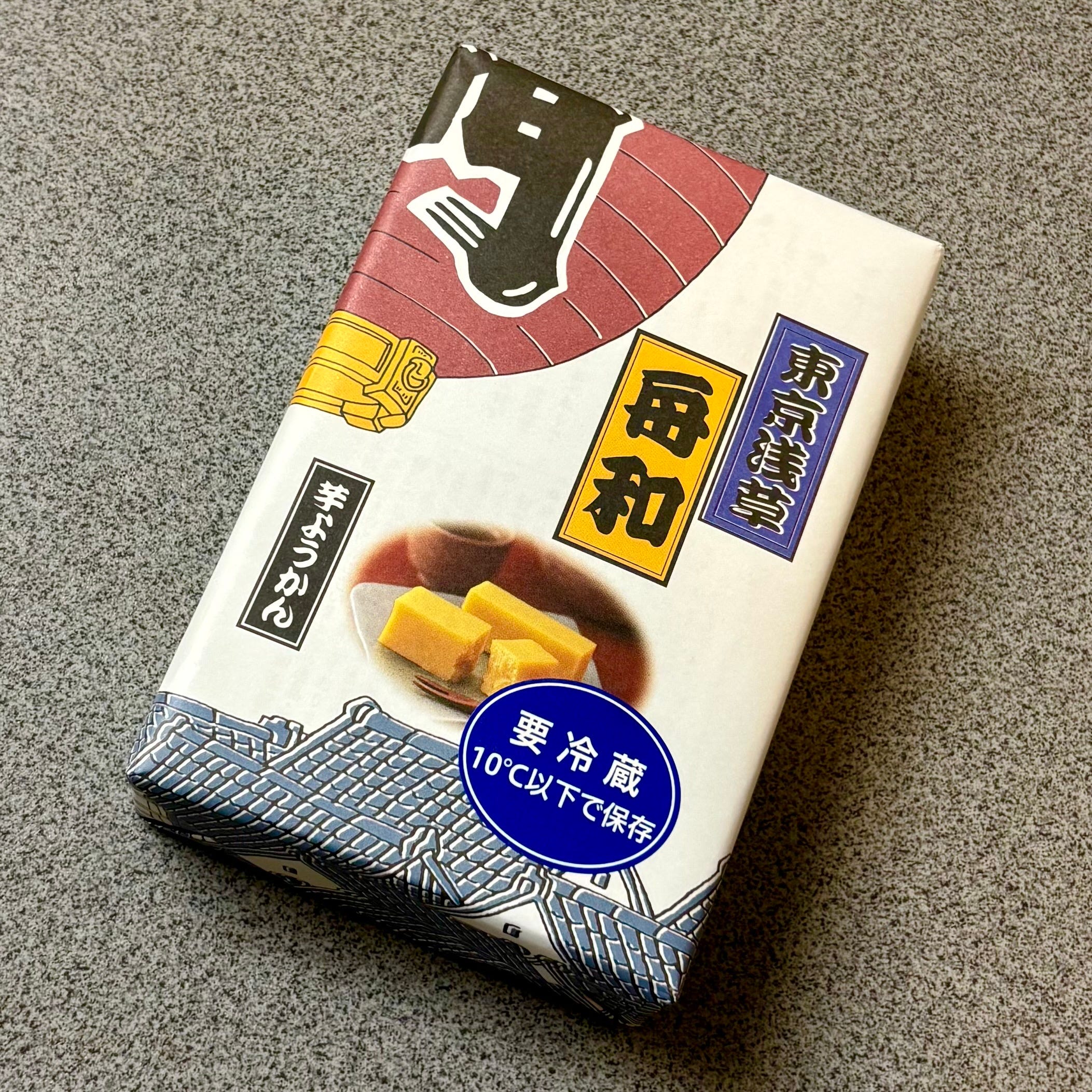
Whenever I bring a box of it back as a souvenir from Tokyo, my mother’s eyes light up. Bringing this beloved confection to her—a woman who rarely visits the capital—fills me with a joy.
I take a bar from the box and rest it upon a dish of black lacquer. Against that deep, lustrous dark, the natural, muted yellow of the sweet potato seems almost luminous, as if glowing from within.
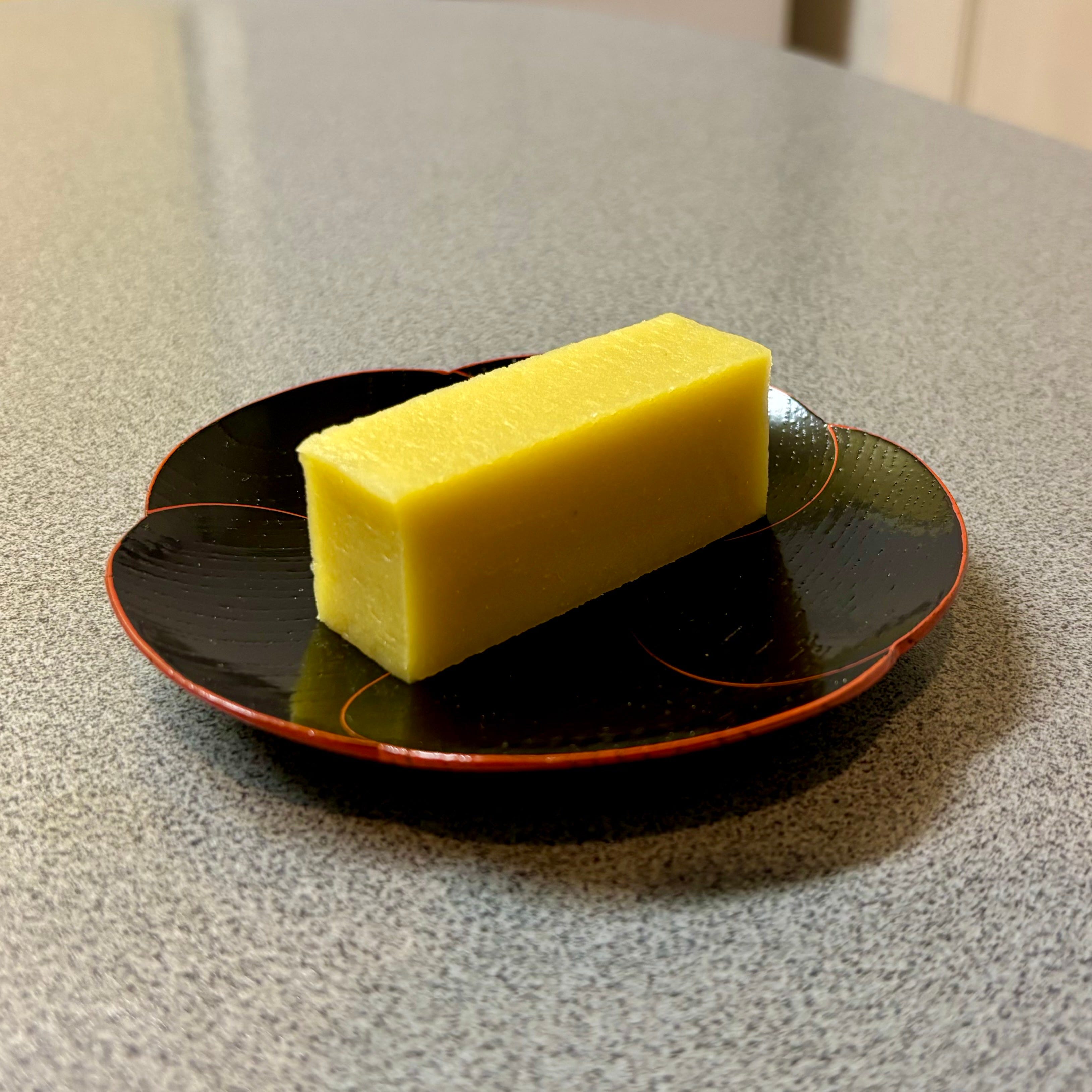
The blade of a black wooden toothpick cuts through it effortlessly.
The sliced surface appears smooth, yet a glance at the fine fibers exposed along the edge captures the raw presence of the root itself, reminding me of its origin.
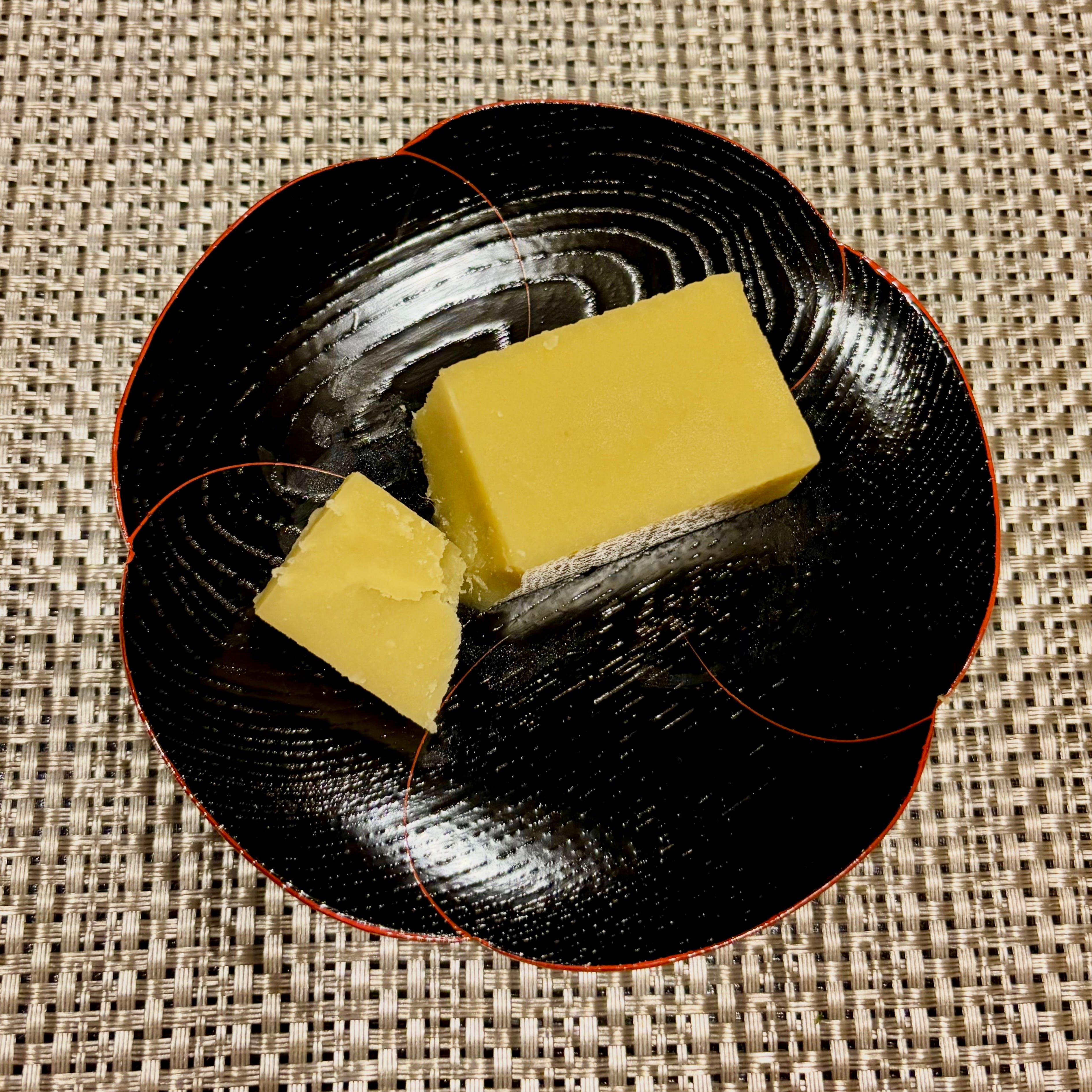
I lift a piece to my lips, meeting its cool, sleek exterior.
Its texture yields cleanly—a crisp, effortless bite entirely unlike the sticky chewiness of standard red bean yokan. As I chew, the rustic aroma of sweet potato rises softly to the nose, as a gentle sweetness spreads across the palate. I can’t help but smile. Moments later, the sweetness glides away, leaving no heavy residue.
It tastes exactly as I remember it.
That realization fills me with a deep, quiet satisfaction. I already know this unadorned sweetness; I am already acquainted with the lingering note of sweet potato at the end. To encounter a taste precisely as anticipated—that, perhaps, is the ultimate luxury.
Sweet potato, sugar, and a pinch of salt. Without cream or spices, there is nowhere to hide the natural variance of the crop.
Yet, no matter when I return to it, the experience never shifts.
I first encountered this taste over a decade ago, on a bullet train heading home after a full day at Tokyo Disneyland. My mother first learned of it thirty years ago from a friend in Asakusa. My father was introduced to it forty years ago, when someone returning from Tokyo brought a box home for the family.
Perhaps this is the true essence of a local souvenir.
A souvenir is always tethered to a specific place, or a specific encounter with someone. Precisely because we meet these flavors so rarely, we seek an unshakeable constancy in them. We long to taste the exact confection we ate years, or even decades, ago.
We are not asking for an "upgrade."
When we open the box and take that first bite, we simply want to confirm that nothing precious has changed. In that singular moment, the familiar flavor pulls memories of distant places and past faces back into the present.
I try to imagine the sheer volume of sweet potatoes that have passed through the hands of Funawa's artisans over the last hundred and twenty years.
Every harvest brings a different crop. One year yields intense sweetness; another brings excess water or stubborn firmness. Even with an identical recipe, the raw material is never the same twice.
To craft the exact same flavor over decades is not a matter of mechanically following instructions. It demands an acute ability to read the condition of every single root.
Rather than forcing every sweet potato into a rigid mold, the artisan reads their subtle differences, gently steering each batch back to that singular, unmistakable flavor.
That is true mastery.
In a rapidly changing Tokyo, a new batch is being prepared today using sweet potatoes slightly different from yesterday’s. Yet I know that the next time I carry that box home, the first bite will remain entirely unchanged.
And I trust it will stay that way half a century from now.
I've never tried imo-yokan before, but it looks so delicious!
Maybe I'll pick some up to take home next time. I wonder if they sell it at Shinagawa Station.
I love Funawa's Imo Yokan!