

The Elvis sandwich has outlived Elvis himself.
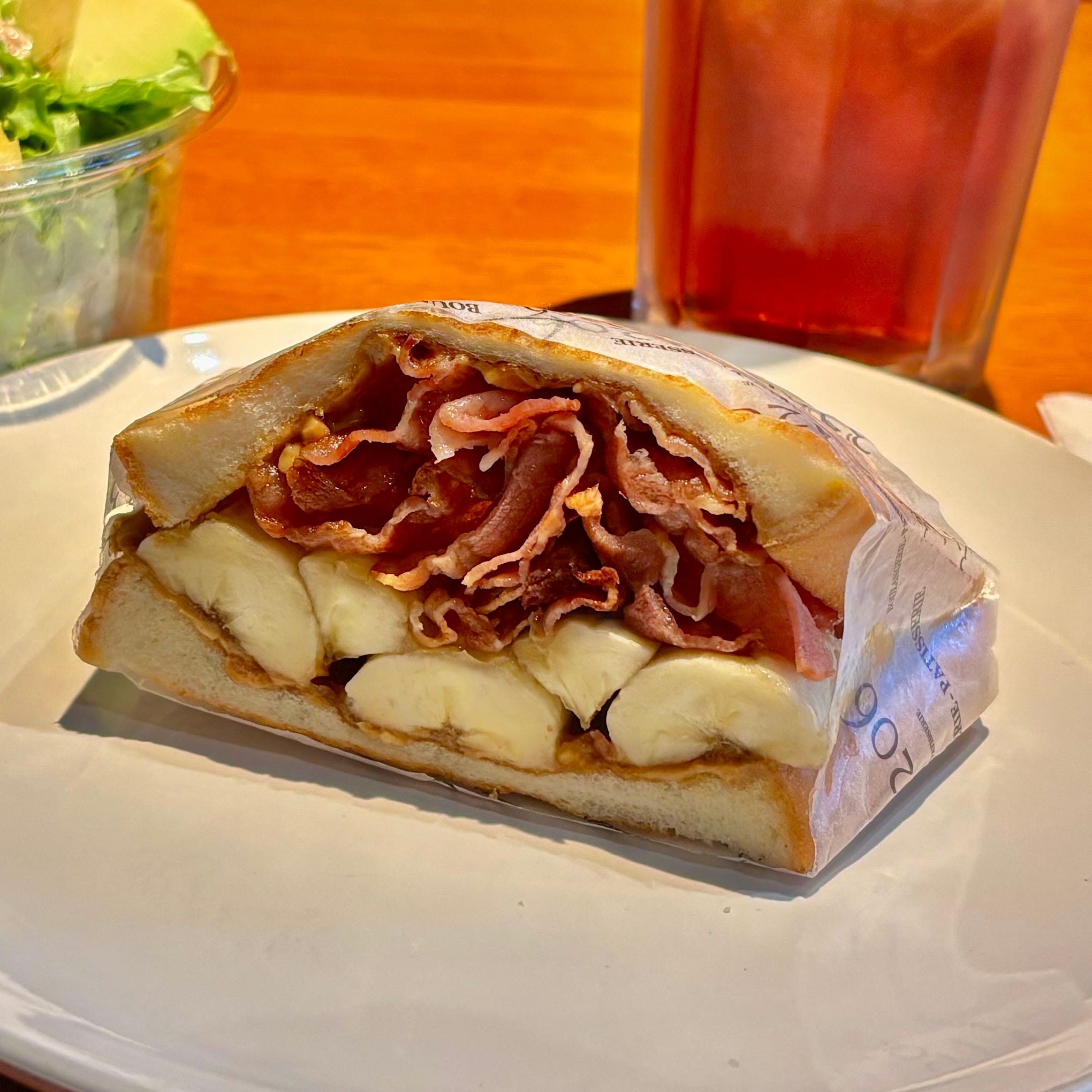
Nearly half a century after his death, people are still making it, ordering it, arguing about it.
Whenever I eat one, I think of my grandmother—not because of its ingredients, but because of the unlikely way they coexist.
The Elvis sandwich shouldn’t work.
There is the crisp saltiness of bacon, the soft sweetness of banana, the rich creaminess of peanut butter, and the crunch of chopped peanuts. Every ingredient seems to have far too much personality to belong in the same sandwich.
And yet they do.
Perhaps it’s because every ingredient accepts the same simple rule: no matter how different they are, they all belong between two slices of bread.
The Elvis sandwich leaves me with a question: How much individuality can flourish within a shared set of rules?
The Proper Housewife
If Elvis had been born a Japanese housewife, he might have looked something like my grandmother.
She kept an immaculate house. Her tempura was exquisite. She was an accomplished seamstress and a certified master of Japanese calligraphy. She also loved shopping and often stayed out late on her own. When she played dolls with me, she committed to every character so completely that one of them once made me burst into tears.
To many people of her generation, she would never have seemed like a proper housewife.
In twentieth-century Japan, after all, a “good housewife” was expected to appear quiet, modest, and self-effacing. But appearances were only part of the job. At its heart, the role was about creating a home where everyone else could flourish. The house was spotless, the meals were nourishing, and family life ran smoothly.
My grandmother excelled at every part of that work. Perhaps that was why she had the freedom to be unmistakably herself.
The Legacy of Karaage
Before she cooked, she always performed the same ritual.
She pressed play on the old boombox. Most days, it was Elvis.
As Elvis filled the kitchen, she lowered the chicken into the oil, one piece at a time.
Her karaage was sweeter than it had any right to be. As the sugar caramelized with the soy sauce, the crust turned the deep brown of coffee instead of the golden color most karaage wears.
Then there was the ginger. She used an almost ridiculous amount of it. Threads of grated ginger clung stubbornly to every piece, even after frying.
No one else’s tasted remotely like it.
Years later, after moving to Tokyo, it was the first taste of home I tried to recreate.
I grated an absurd amount of ginger, cut the chicken into small pieces, let it soak in that improbably sweet marinade, Then lowered it into the oil.
When it was finished, I called my mother.
“I made Grandma’s karaage.”
“Really?” she laughed. “We’ve been making it too.”
The recipe exists nowhere except in our kitchens. It survives each time someone reaches for more ginger than the recipe could possibly justify.
Bananas have no business being in a sandwich. Neither, perhaps, does that much ginger in fried chicken. And yet both feel inevitable once you’ve tasted them.
Perhaps that’s what outlives us.
Not the things that break the rules, but the things that make the old rules feel new.
Somewhere in my family, someone is probably grating far more ginger than any recipe recommends.
Someone taps Play on an iPhone.
Oil begins to crackle.
Elvis starts to sing.
“I want to stick around a while and get my kicks.”
I really enjoyed this. The part that stayed with me most was the idea that individuality does not always live outside tradition. Sometimes it survives inside the rules, in the extra ginger, the sweeter marinade, or the way one person makes a familiar dish impossible to separate from them. I thought the Elvis sandwich was such a good frame for that, because it made the piece less about food combinations and more about how personality can remain inside what gets passed down.